
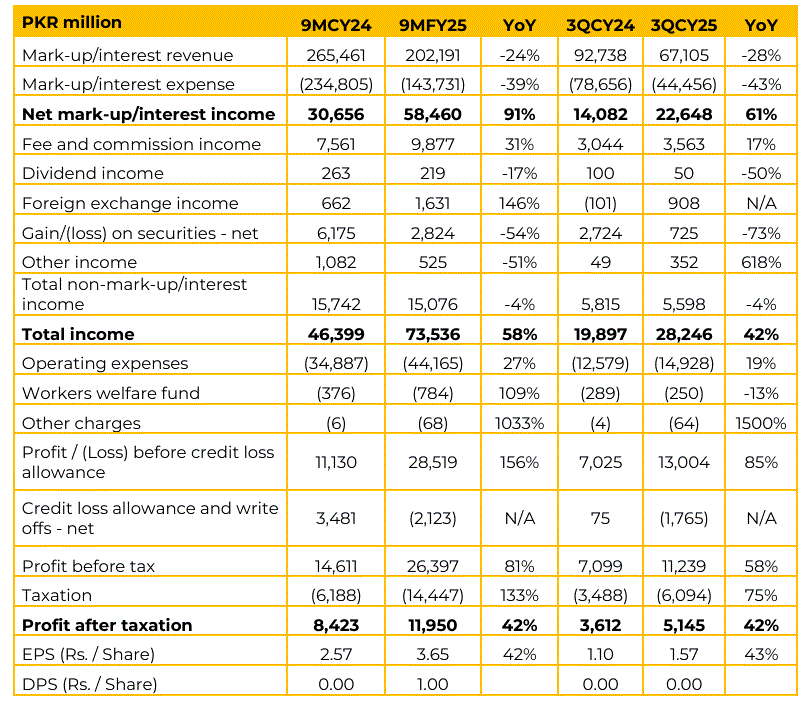
BOP has reported earnings per share of PKR 3.65 in 9MCY25 (9MCY24: PKR 2.57). Furthermore, in 3QCY25 the company reported EPS of PKR 1.57 (3QCY24: PKR 1.10).
The improvement in the Cost-to-Income ratio is primarily attributed to the substantial increase in income/revenue, rather than severe cost cutting, as cost control has always been maintained. The dependency on public sector deposits has reduced. Total public sector deposits now account for approximately 50% of the total portfolio, down from 70% previously. Private deposit growth has seen an 80% increase since 2021, with the bank projecting to close the year near PKR 1 trillion in private deposits. BOP is actively pursuing digital transformation. It is recognized as Pakistan’s largest digital lender, having disbursed PKR 1,370 billion to nearly 1 million borrowers.
BOP is also the top credit card issuer, with over 937,000 cards in use. BOP serves 44% of all SME borrowers in Pakistan since 2020. The bank leads all commercial banks, serving 18% of Pakistan’s total agricultural borrowers. The Kissan Card portfolio stands at PKR 60 billion. As of November 13th, 85% of this money was recovered, with expectations of 98-99% recovery by the November 15th maturity date.
BOP’s share in housing finance has dramatically increased from 1.3% to 33% over the last couple of years, disbursing approximately PKR 120 billion across over 100,000 housing loans. The bank aims to leverage its large database, such as the 1 million Kissan Card database, to build on commercial terms even if government schemes cease, ensuring continued momentum. PKR 1.765 billion was provisioned in Q3.
This increase largely relates to credit deterioration (movement in accounts) and compliance with IFRS 9 accounting requirements, especially related to the seasonal increase in the agriculture portfolio. The current NPL to book ratio is approximately 6.5%, which management stated is in line with the market average and better than the market average of over 7.5%.
Management noted that BOP was part of the flood survey, allowing proactive mitigation measures. While agriculture and SME sectors were most vulnerable, the overall impact was minimal. 70% of the agriculture portfolio is secured by First Loss Guarantees (20%-30%) from the government. The remaining 30% is 95% collateralized. Only 2% of agricultural borrowers were actually identified as flood-affected, representing an amount of only PKR 650 million, which is fully collateralized. No material negative impact is expected.
Management emphasized that they never committed to a quarterly dividend, but given the strong performance and solid balance sheet footing, analysts should expect a historic Annual Dividend. Going forward, the bank is highly focused on core banking and is not actively pursuing Open Market Operations or extensive borrowing to build the balance sheet, largely due to being an under-capitalized bank relative to peers and the desire to avoid high risk. BOP currently has 900 branches.
Plans to expand by another 100 branches by 2027 (50 in 2026, 50 in 2027). Rural areas are considered more lucrative for deposit acquisition due to lower competition. Management believes that interest rate will remain flattish at 11%.
However, the President feels that there’s a marginal room for rate cut, but not substantial and that the current level of interest rate makes more sense. BOP is targeting the corporate sector primarily through Cash Management Solutions and digital services, capitalizing on the government’s “Cashless Pakistan” initiative.
Competition is high in traditional corporate lending, so focus remains strong on SME/Agri/Commercial segments. BOP is the largest commercial bank in logistics lending. This includes commercial vehicles, prime movers, tractors, and farm to-market vehicles. The bank intends to continue heavily investing in this lucrative segment.
Important Disclosures
Disclaimer: This report has been prepared by Chase Securities Pakistan (Private) Limited and is provided for information purposes only. Under no circumstances, this is to be used or considered as an offer to sell or solicitation or any offer to buy. While reasonable care has been taken to ensure that the information contained in this report is not untrue or misleading at the time of its publication, Chase Securities makes no representation as to its accuracy or completeness and it should not be relied upon as such. From time to time, Chase Securities and/or any of its officers or directors may, as permitted by applicable laws, have a position, or otherwise be interested in any transaction, in any securities directly or indirectly subject of this report Chase Securities as a firm may have business relationships, including investment banking relationships with the companies referred to in this report This report is provided only for the information of professional advisers who are expected to make their own investment decisions without undue reliance on this report and Chase Securities accepts no responsibility whatsoever for any direct or indirect consequential loss arising from any use of this report or its contents At the same time, it should be noted that investments in capital markets are also subject to market risks This report may not be reproduced, distributed or published by any recipient for any purpose.