

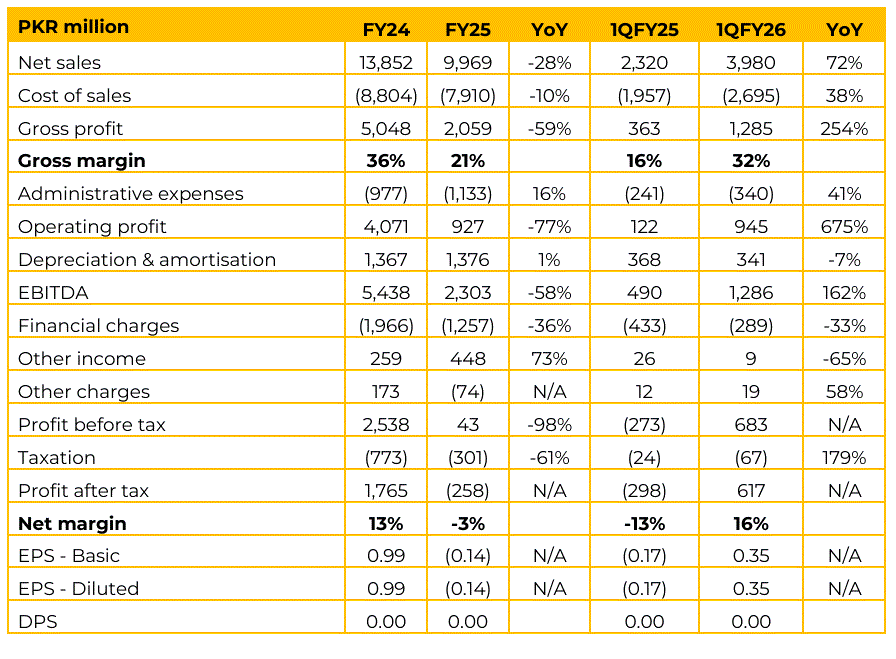
PIBTL has reported loss per share of PKR 0.14 in FY25 (EPS FY24: PKR 0.99). Furthermore, in 1QFY26 the company reported EPS of PKR 0.35 (LPS 1QFY25: PKR 0.17). Volume handled by the company declined by 25% to 4.79 million ton in FY25, due to the temporary suspension of operations after the November 19, 2024, fire incident at the terminal and a broader decline in seaborne coal imports.
Cement factories were the biggest client at 47% of handled volume, followed by power plants at 21%. Imported-coal demand strengthened in the first half of 2026, supported by improved economic activity and a decline in international coal prices. Coal-consuming industries are expected to maintain seaborne coal imports, driven by prevailing price trends and favorable logistics. Ongoing monetary policy easing is expected to stabilize the macroeconomic environment further, supporting continued import activity.
Concession period is for 30 years, extendable for another 30 years. The current concession is expected to end around 2045 2046. PIBTL has been selected as the terminal for exporting Reko Diq’s copper and gold concentrate. This is viewed as a “life changing opportunity” for the company and Pakistan. PIBTL was selected over six other port terminals due to its existing infrastructure and storage area.
Operations are expected to commence in 2028, possibly 2029. The project is expected to export $2 billion/year of copper and gold concentrate, and PIBTL hopes to capture all of this quantity, utilizing its export line. Reko Diq Mining Company is expected to invest approximately $150 million for its infrastructure within the terminal, including building a dedicated shed to house the cargo. PIBTL’s existing export system is being made ready.
While the terms are a commercial understanding and cannot be disclosed, management indicated that the rates would be better rates than current handling fees. The final agreement is hoped to be finalized and construction started within the current calendar year or by June 5, 2026. PIBTL is actively marketing and sees an opportunity to handle diverted cement export cargo. A major challenge in capturing this cargo is the high royalty cost levied by the port authorities.
Total initial loans were USD 125 million, consisting of a $55 million foreign currency loan and USD 72 million in local loans, structured over 12 years. Only two installments remain on the foreign loans, expected to be paid off this year. While, only two years remain on the local loans. Outstanding payables are high, approximately PKR 6 billion, with about PKR 4 billion owed for royalty payments to Port Qasim Authority.
The significant contraction in volumes and 40% revenue drop in the last financial year led to delays in paying PQA. Management plans to manage or pay off these large payables, possibly in a one-time payment, once the foreign currency loans are repaid. Local coal is lower quality but poses a challenge, as power plants are incorporating it into their coal mix, potentially reducing the volume of seaborne imported coal handled by PIBTL. The closure of the Afghan border indirectly benefits PIBTL, as clients in Northern Pakistan must then import coal through the seaborne channel (via Qasim/PIBTL) rather than obtaining cheaper supplies over the border.
Important Disclosures
Disclaimer: This report has been prepared by Chase Securities Pakistan (Private) Limited and is provided for information purposes only. Under no circumstances, this is to be used or considered as an offer to sell or solicitation or any offer to buy. While reasonable care has been taken to ensure that the information contained in this report is not untrue or misleading at the time of its publication, Chase Securities makes no representation as to its accuracy or completeness and it should not be relied upon as such. From time to time, Chase Securities and/or any of its officers or directors may, as permitted by applicable laws, have a position, or otherwise be interested in any transaction, in any securities directly or indirectly subject of this report Chase Securities as a firm may have business relationships, including investment banking relationships with the companies referred to in this report This report is provided only for the information of professional advisers who are expected to make their own investment decisions without undue reliance on this report and Chase Securities accepts no responsibility whatsoever for any direct or indirect consequential loss arising from any use of this report or its contents At the same time, it should be noted that investments in capital markets are also subject to market risks This report may not be reproduced, distributed or published by any recipient for any purpose.