

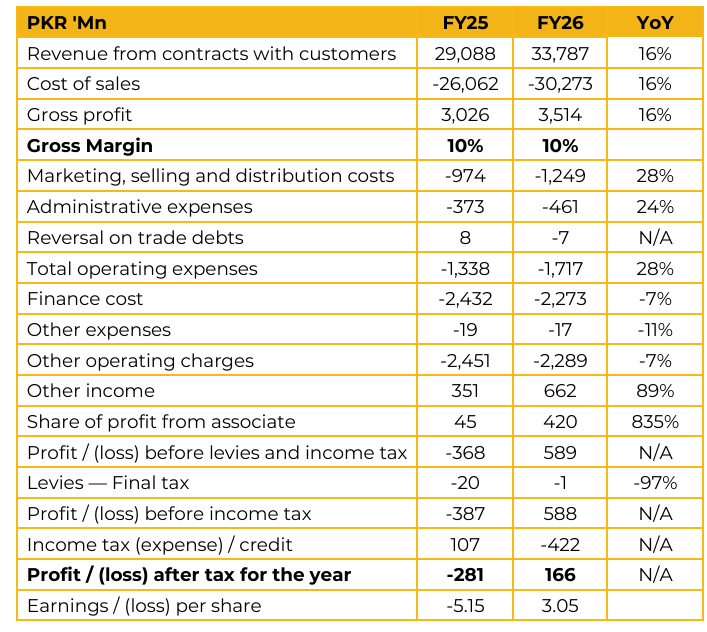
Pakistan Cables Limited (PCAL) reported earnings per share of PKR 3.05 for FY26, compared to loss per share of PKR 5.15 in FY25. The company has in-house, backward integrated annual capacities of 30,000 metric tons for copper, 30,000 metric tons for aluminum, and 24,000 metric tons for PVC compounding.
The company is currently operating at 50%–60% capacity utilization. Rooftop solar capacity has been increased from 2.0 MW to 2.3 MW. PCAL entered into a 20 year agreement with Clean Energy Modaraba to establish a 7.5 MW wind turbine project at its Nooriabad facility. The project is expected to generate annual energy cost savings of PKR 100–150 million. The long term debt to equity ratio has declined from a peak of 28% to 4%, following repayments of Nooriabad project financing and the TERF facility. Receivables increased from PKR 7.5 billion to PKR 9.2 billion, reflecting substantial credit sales in June.
This increased short term borrowing requirements and kept finance costs elevated. PCAL fully divested its PKR 87 million investment in the construction business to eliminate its exposure to security risks in Balochistan. Aluminum’s contribution to PCAL’s total sales mix increased from 10% to 25%. The company exports to more than 40 countries and accounts for approximately 70% of Pakistan’s total cable exports.
The timing and execution of the DISCO privatization process remain uncertain. Nevertheless, the government’s plans to privatize major distribution companies, including IESCO, FESCO and GEPCO, could drive investment in grid efficiency and support demand for conductors and medium and high voltage cables. PCAL operates as a metal converter, earning a conversion margin. In a strong market, increases in metal prices are passed on to customers.
Pricing lags are managed through one to two month inventory averaging and by locking in final L/C pricing upon shipment arrival. Operating two plants during the transition to Nooriabad resulted in substantial additional overheads, including transportation, accommodation and staffing costs. PCAL also operates with a unionized workforce within a formal corporate structure. With operations now fully consolidated at Nooriabad and green energy projects operational, manufacturing costs are declining, supporting expectations of a recovery in margins. Some DISCOs, including IESCO, are already relatively well managed and efficient. Consequently, their privatization may not immediately translate into substantial grid investment by new owners.
Important Disclosures
Disclaimer: This report has been prepared by Chase Securities Pakistan (Private) Limited and is provided for information purposes only. Under no circumstances, this is to be used or considered as an offer to sell or solicitation or any offer to buy. While reasonable care has been taken to ensure that the information contained in this report is not untrue or misleading at the time of its publication, Chase Securities makes no representation as to its accuracy or completeness and it should not be relied upon as such. From time to time, Chase Securities and/or any of its officers or directors may, as permitted by applicable laws, have a position, or otherwise be interested in any transaction, in any securities directly or indirectly subject of this report Chase Securities as a firm may have business relationships, including investment banking relationships with the companies referred to in this report This report is provided only for the information of professional advisers who are expected to make their own investment decisions without undue reliance on this report and Chase Securities accepts no responsibility whatsoever for any direct or indirect consequential loss arising from any use of this report or its contents At the same time, it should be noted that investments in capital markets are also subject to market risks This report may not be reproduced, distributed or published by any recipient for any purpose