
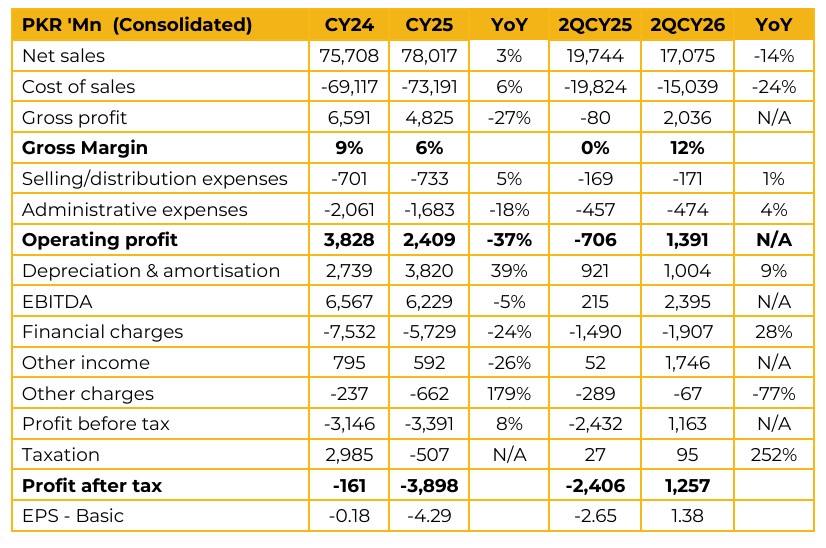
Engro Polymer Limited (EPCL) reported consolidated loss per share of PKR 4.29 for CY25, compared to loss per share of PKR 0.18 in CY24. Furthermore, in 2QCY26, the company reported earnings per share of PKR 1.38, compared to loss per share of PKR 2.65 in the same period last year (SPLY). PVC prices peaked in March 2026 amid the US Iran conflict but declined rapidly thereafter as supply from Chinese carbide based producers and US manufacturers increased. Global caustic soda prices are gradually returning to pre war levels due to continued oversupply from China.
Hydrogen Peroxide prices, however, remain above pre war levels due to elevated freight costs. PVC accounts for approximately 78% of revenue. Production reached 116 KT despite a plant shutdown in April. Caustic Soda sales remained steady, supported by stable demand from key end user industries.
The Hydrogen Peroxide business continues to strengthen, with H1 sales volumes increasing to 10–11 KT, compared with around 3 KT in the SPLY. The levy formula was revised in March 2026, reducing the cost from PKR 1,406/MMBtu to approximately PKR 365/MMBtu by May. Management expects this change to have a PKR 3–4bn positive impact on the P&L. The company’s decision to maintain a relatively high cash balance is primarily linked to an upcoming grid power project.
Meanwhile, long term debt was raised to finance projects aimed at improving operational efficiency. In the Hydrogen Peroxide segment, Bangladeshi producers continue to benefit from subsidized energy costs. However, the imposition of anti dumping duties requires specific evidence demonstrating that these producers are selling below cost in the Pakistani market. Approximately PKR 1.2–1.3bn represents a one off accounting remeasurement gain related to a settlement agreement with the government regarding the SIDC/GIDC litigation. The remaining portion of other income is primarily attributable to interest income earned on short-term investments. In PVC, anti dumping duties have recently been imposed on imports from the US and Indonesia following an evaluation by the NTC.
Ongoing conflicts in the Gulf have resulted in disruptions to Ethylene and EDC supply. While current inventory levels remain sufficient to meet market demand, higher procurement and shipping costs are expected to weigh on margins during the coming half.
Management expects approximately 2mn tons of additional ethylene capacity to come online globally during the year. Despite volatility in global PVC prices, domestic PVC demand is expected to remain robust. Management remains optimistic about closing the year with higher sales volumes compared with SPLY. Demand is also expected to receive support from anticipated government measures aimed at stimulating the housing and construction sectors. Ethylene is produced from naphtha sourced primarily from the Middle East. Consequently, any disruption in the availability of naphtha due to geopolitical tensions could directly affect ethylene availability and, in turn, the company’s PVC production chain.
Important Disclosures
Disclaimer: This report has been prepared by Chase Securities Pakistan (Private) Limited and is provided for information purposes only. Under no circumstances, this is to be used or considered as an offer to sell or solicitation or any offer to buy. While reasonable care has been taken to ensure that the information contained in this report is not untrue or misleading at the time of its publication, Chase Securities makes no representation as to its accuracy or completeness and it should not be relied upon as such. From time to time, Chase Securities and/or any of its officers or directors may, as permitted by applicable laws, have a position, or otherwise be interested in any transaction, in any securities directly or indirectly subject of this report Chase Securities as a firm may have business relationships, including investment banking relationships with the companies referred to in this report This report is provided only for the information of professional advisers who are expected to make their own investment decisions without undue reliance on this report and Chase Securities accepts no responsibility whatsoever for any direct or indirect consequential loss arising from any use of this report or its contents At the same time, it should be noted that investments in capital markets are also subject to market risks This report may not be reproduced, distributed or published by any recipient for any purpose.