

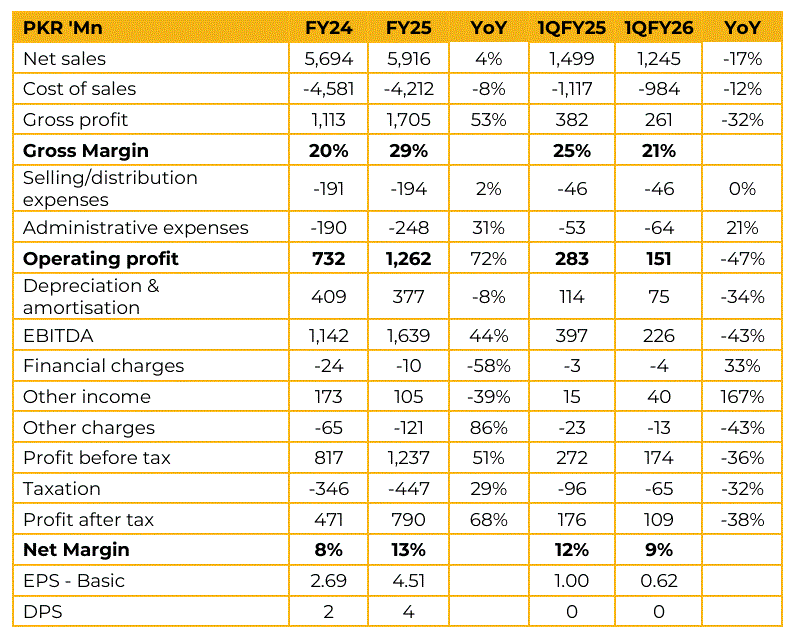
Descon Oxychem Limited (DOL) reported earnings per share of PKR 4.51 for FY25, compared to PKR 2.69 in FY24. Furthermore, in 1QFY26, the company reported earnings per share of PKR 0.62, compared to earnings per share of PKR 1.00 in the same period last year (SPLY).
The management sees significant potential to rebuild export volumes, which have been declining over the past few years. Their target is to increase current export volumes by at least 50%. In the Middle East, the company has identified strong opportunities in surface water treatment and food packaging segment.
The company has also made progress on its spray grade product, which is expected to generate additional volumes in the food grade market. Notably, food grade products command a significant premium over technical grade products. Export margins, however, remain lower than domestic margins for technical grade products, as the company absorbs freight costs to stay competitive internationally.
The total domestic market stands at roughly 80,000 tons annually, with about 90% of demand coming from the textile industry. The company is actively engaging with regulatory authorities to curb misuse of the Export Facilitation Scheme (EFS) and to push for the extension of antidumping duties to counter unfair competition. Combined expected production is estimated at around 67,000 tons this year, with a steady upward trend.
Management expects production from the new competitor estimated at 36,000 tons to primarily replace low cost imports previously originating from Bangladesh. The company continues to face headwinds from widespread misuse of the EFS facility, with nearly 80% of imports entering the country through EFS channels.
The company is installing a 2-megawatt solar power plant, which is expected to generate substantial savings in electricity costs. Current power requirements range between 3 and 3.5 MW. For FY26, the government has revised the gas blend ratio from 75% RLNG and 25% system gas to a 50:50 mix of RLNG and system gas.
The company also plans to undertake its annual turnaround during the year. Import pricing continues to set the market benchmark, with Korean products landing at around USD 450 per ton and Bangladeshi products arriving at approximately USD 325 per ton.
Important Disclosures
Disclaimer: This report has been prepared by Chase Securities Pakistan (Private) Limited and is provided for information purposes only. Under no circumstances, this is to be used or considered as an offer to sell or solicitation or any offer to buy. While reasonable care has been taken to ensure that the information contained in this report is not untrue or misleading at the time of its publication, Chase Securities makes no representation as to its accuracy or completeness and it should not be relied upon as such. From time to time, Chase Securities and/or any of its officers or directors may, as permitted by applicable laws, have a position, or otherwise be interested in any transaction, in any securities directly or indirectly subject of this report Chase Securities as a firm may have business relationships, including investment banking relationships with the companies referred to in this report This report is provided only for the information of professional advisers who are expected to make their own investment decisions without undue reliance on this report and Chase Securities accepts no responsibility whatsoever for any direct or indirect consequential loss arising from any use of this report or its contents At the same time, it should be noted that investments in capital markets are also subject to market risks This report may not be reproduced, distributed or published by any recipient for any purpose.