

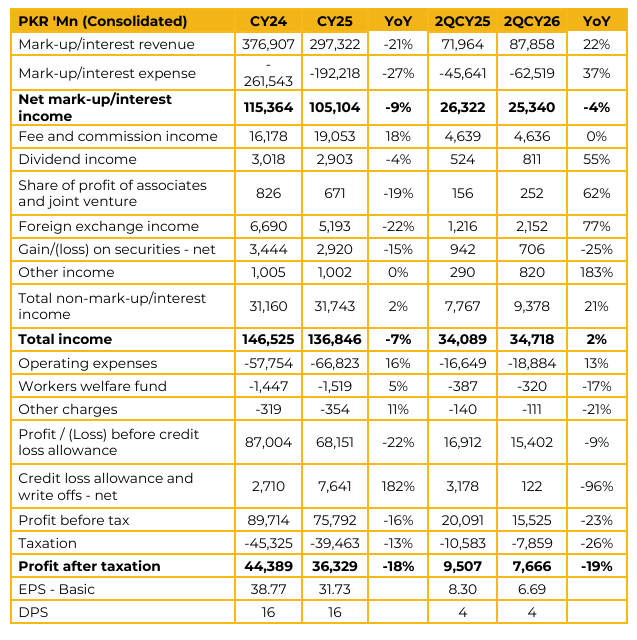
Allied Bank Limited (ABL) reported earnings per share of PKR 31.73 for CY25, compared to earnings per share of PKR 38.77 in CY24. Furthermore, in 2QCY26, the company reported earnings per share of PKR 6.69, compared to earnings per share of PKR 8.30 in the same period last year (SPLY). As of June 30, 2026,
Allied Bank operates a total network of 1,537 branches, comprising 1,126 conventional branches, 31 dedicated Islamic branches, and 389 Islamic banking windows. Total customer accounts have surpassed 11mn, while total assets reached PKR 3,755bn, registering an 11% increase from PKR 3,370bn in Dec’25.
Net investments expanded by 16% to PKR 2,483bn, compared with PKR 2,127bn in Dec’25, reflecting the bank’s strategy of deploying surplus liquidity into investment securities. Advances declined slightly to PKR 757bn from PKR 780bn, reflecting a cautious lending approach and continued portfolio optimization. Meanwhile, deposits expanded by 12% to PKR 2,618bn from PKR 2,346bn in Dec’25.
The CASA ratio remained at 80%, with CASA deposits standing at PKR 2,091 bn. Notably, current accounts surpassed the PKR 1 trillion milestone for the first time in ABL’s history. The Capital Adequacy Ratio remained robust at 24.9%, among the highest in the banking industry, supported by an equity base of PKR 258 bn.
ABL is targeting a cost to income ratio of 49–50%. Non performing loans remained contained at PKR 11.7 bn, while the infection ratio stood at a low 1.5%, remaining among the lowest across peer banks. Gross ADR stood at 29.4%. ABL recorded 12% deposit growth during the first six months of the year and expects full year deposit growth to remain around 12–13%.
Current accounts are expected to settle at approximately 39–40% of the overall deposit mix. Given prevailing global and regional geopolitical uncertainties, management acknowledged that forecasting remains challenging. Nevertheless, it expects the policy rate to remain unchanged at current levels through the end of 2026. The average yield on the fixed rate portfolio stands at slightly above 11%, while the floating rate portfolio yields approximately 12%.
Spreads on individual floating rate instruments range between 80–100bps, with some instruments carrying spreads of up to 180bps depending on their purchase dates, resulting in an overall average floating portfolio yield of around 12%. ABL’s PIB portfolio is broadly balanced between fixed and floating instruments, with 51% allocated to floating rate PIBs and 49% to fixed rate PIBs. Management expects healthy fee income growth, supported by a strong increase in debit card transactions and new user acquisitions. Banks are now required to bear the cost of rebates paid to overseas remittance partners. While this is expected to increase operating costs, ABL expects to fully offset the impact through higher trade volumes and improved exchange margins.
Important Disclosures
Disclaimer: This report has been prepared by Chase Securities Pakistan (Private) Limited and is provided for information purposes only. Under no circumstances, this is to be used or considered as an offer to sell or solicitation or any offer to buy. While reasonable care has been taken to ensure that the information contained in this report is not untrue or misleading at the time of its publication, Chase Securities makes no representation as to its accuracy or completeness and it should not be relied upon as such. From time to time, Chase Securities and/or any of its officers or directors may, as permitted by applicable laws, have a position, or otherwise be interested in any transaction, in any securities directly or indirectly subject of this report Chase Securities as a firm may have business relationships, including investment banking relationships with the companies referred to in this report This report is provided only for the information of professional advisers who are expected to make their own investment decisions without undue reliance on this report and Chase Securities accepts no responsibility whatsoever for any direct or indirect consequential loss arising from any use of this report or its contents At the same time, it should be noted that investments in capital markets are also subject to market risks This report may not be reproduced, distributed or published by any recipient for any purpose.