

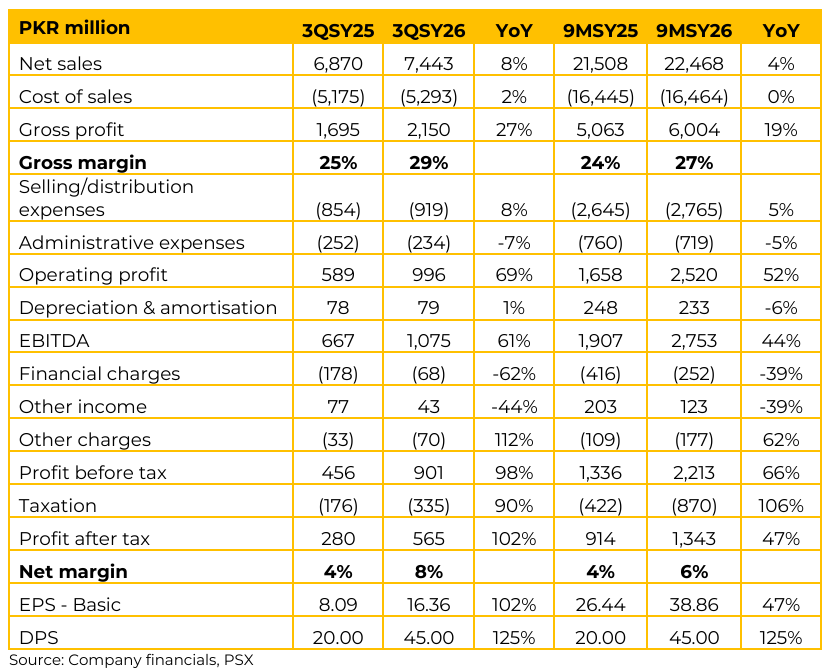
ARPL reported earnings per share of PKR 16.36 in 3QSY26 (3QSY25: PKR 8.09). Furthermore, in 9MSY26 earnings per share were reported to be PKR 38.86 (9MSY25: PKR 26.44). In 9MSY26, gross margins expanded to 26.7%, approaching management’s long-term benchmark target of 30%+ due to operational cost controls and energy efficiency initiatives. Net margin recovered to 6.0%, returning toward historical benchmark levels.
Management noted that the operations are organized into two main divisions: Textile Effects (TE) accounting for 90% of net sales, and Packaging Technologies (PT) accounting for 10% of net sales in 9M FY26. TE supplies specialized pretreatment, dyeing, printing, and finishing chemicals for denim, activewear, formal wear, swimwear, and home textiles.
Archroma supports four of the global top 10 denim producers located in Pakistan. PT serves paper/packaging, tissues/towels, wood, paints/coatings, construction, and water management. Archroma chemicals are present in products from most major paint producers. Construction is a new and expanding segment for the company.
Other applications include packaging, paper, tissues, toweling solutions, and wood. While Chinese manufacturers dominate bulk commodity chemicals, ARPL maintains strong pricing power in value-added specialty chemicals, smaller customized order batches, and specialized finishing (e.g., activewear, premium denim, Sialkot technical gear). Management rejected claims of domestic market share loss, highlighting market share gains across denim and finishing segments. ARPL has transitioned ~40% of energy requirements to renewables at the Jamshoro plant and nearly 100% at the Landhi plant, driving an overall energy consumption/cost reduction of ~10%. Super Systems is an end-to-end system designed for process excellence. These systems use transparent calculators to show customers how they can reduce costs related to heat, water, and treatment through efficient chemical usage.
Core raw materials (monomers and petrochemical derivatives) are 70–80% imported from China and East Asia. The company maintains no sourcing from India and shifted away from Middle Eastern suppliers due to regional instability. ARPL operates a nationwide setup capable of delivering products to any industrial cluster in Pakistan within 3 days. Toll manufacturing contributes a very small/negligible portion of total revenues.
Going forward, US import tariffs on competing manufacturing nations are anticipated to create medium-to-long-term export opportunities for Pakistani textile exporters, driving sustained demand for ARPL’s processing solutions. Integration of the Huntsman Textile Effects acquisition continues to expand the product pipeline. The company is shifting focus toward high-margin specialty products where “pricing power” is derived from the cost-savings the chemicals provide to the customer’s industrial process.
Important Disclosures
Disclaimer: This report has been prepared by Chase Securities Pakistan (Private) Limited and is provided for information purposes only. Under no circumstances, this is to be used or considered as an offer to sell or solicitation or any offer to buy. While reasonable care has been taken to ensure that the information contained in this report is not untrue or misleading at the time of its publication, Chase Securities makes no representation as to its accuracy or completeness and it should not be relied upon as such. From time to time, Chase Securities and/or any of its officers or directors may, as permitted by applicable laws, have a position, or otherwise be interested in any transaction, in any securities directly or indirectly subject of this report Chase Securities as a firm may have business relationships, including investment banking relationships with the companies referred to in this report This report is provided only for the information of professional advisers who are expected to make their own investment decisions without undue reliance on this report and Chase Securities accepts no responsibility whatsoever for any direct or indirect consequential loss arising from any use of this report or its contents At the same time, it should be noted that investments in capital markets are also subject to market risks This report may not be reproduced, distributed or published by any recipient for any purpose.