
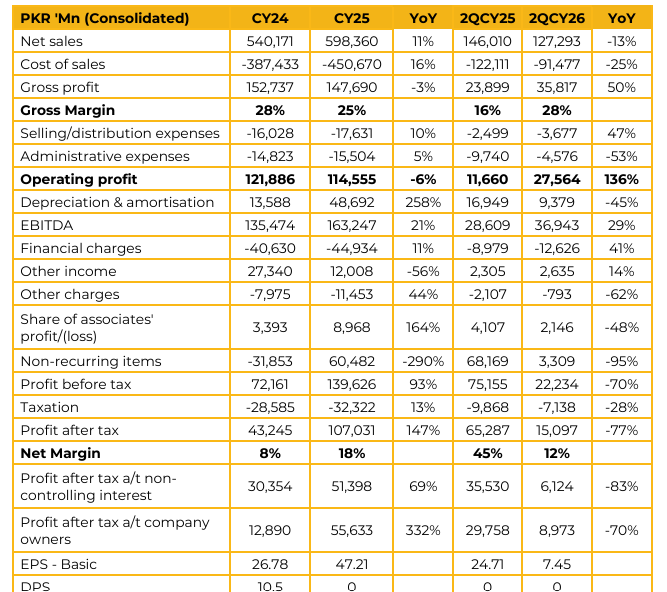
Engro Holdings Limited (ENGROH) reported earnings per share of PKR 47.21 for CY25, compared to earnings per share of PKR 26.78 in CY24. Furthermore, in 2QCY26, the company reported earnings per share of PKR 7.45, compared to earnings per share of PKR 24.71 in the same period last year (SPLY). Engro Connect currently manages a portfolio of 15,500 tower sites, with a tenancy ratio of 1.35x–1.36x.
Connect captured a dominant 60% share of collocations and 45% of total operator rollouts, highlighting its strong competitive positioning in the domestic tower market. Short term borrowings currently stand at zero, while long term debt is approximately PKR 80bn. Long term debt is expected to exceed PKR 100bn following the final payments related to the PMCL (Jazz) tower transaction, due on January 3, 2027.
Annual capital expenditure for the tower vertical is expected to remain above PKR 20bn. Connect is also working with FTTH (Fiber to the Home) players to fiberize its tower footprint. The company expects to launch its proprietary fiber product by October/November 2026. Despite challenging product affordability dynamics, management expects robust farmer economics and strong wheat related demand to support the liquidation of Urea inventory by December 2026. Industry inventory at year end is expected to stand at roughly 300k tons, with Engro expected to account for the largest share. SECMC remains on track to announce the Commercial Operation Date for Phase 3 in September 2026. The expansion will enable coal supply to Lucky Electric in Karachi, supported by the development of a third rail link.
The company has successfully secured a 30 year implementation agreement for Vopak terminal operations, providing a long term platform for future business development and expansion opportunities. For FCEPL, management views the ongoing turnaround as structural and sustainable, supported by a rising contribution from high margin, value added products in the sales mix, effective cost optimization, and disciplined pricing actions that have protected margins without compromising market share.
The independent tower company business is becoming increasingly formalized in Pakistan, and Engro continues to enjoy a significant first mover advantage. While it remains too early to assess PTCL’s exact strategy, Engro is closely monitoring developments and could potentially participate as a full or partial bidder, or alternatively compete with PTCL. Currently, approximately 3,500 sites, representing 23%–24% of the total 15,500 tower portfolio, are solarized.
The older tower portfolio acquired through Deodar has relatively lower solarization, while the newer enfrashare portfolio is approximately 50% solarized. Connect targets the installation of around 500 solar sites annually, which could add 2,000–2,500 solarized sites and increase total solarization to approximately 5,500–6,000 sites by 2030. Management views solarization as a pass through investment that generates attractive long term yields.
The current tenancy ratio stands at 1.35x–1.36x, while Connect is targeting 1.85x–1.90x by 2030, implying an increase of approximately 0.1x per year. Management expects 5G rollouts to accelerate tenancy growth, as shorter wavelengths and lower signal penetration under 5G require a denser network of capacity and infill sites. Currently, Jazz and Zong operate approximately 17,000 points of presence (POPs) each.
The combined Telenor-Ufone entity has approximately 24,000 POPs, but is expected to decommission around 5,000–6,000 duplicate sites, eventually stabilizing at approximately 19,000–20,000 POPs. To remain competitive, all three major operators are expected to deploy around 1,000–1,500 new POPs annually. Given Connect’s competitive footprint, management expects the company to capture a meaningful share of these incremental rollouts. The GIDC bill has been tabled in the National Assembly, but has not yet been fully enacted.
The proposed amendment seeks to impose a retrospective levy. Engro maintains that GIDC was never legally applicable to its operations and continues to hold active stay orders against the levy. Diesel consumption is a direct pass through cost to Mobile Network Operators (MNOs) under existing lease agreements and therefore has a neutral impact on Connect’s margins. There were no changes to the group’s core accounting policies or estimates during H1 2026. Meanwhile, the due diligence process for the divestment of the EPCL is progressing smoothly. Negotiations are at an advanced stage, with only a limited number of commercial matters remaining to be finalized. Switching the polymer plant from gas-fired power to the national grid is expected to generate annual post tax savings of approximately PKR 5–6bn under a full conversion scenario, and around PKR 4–4.5bn under a partial conversion scenario.
The project will be funded through cash reserves already available on the balance sheet. A partial transition to grid is expected to take approximately 12–18 months. Active fiberization currently stands at approximately 20% for Jazz towers and 4%–5% for Ufone/Telenor towers. Connect is partnering with FTTH players to extend fiber strands to its tower sites, supporting improved network quality and positioning the portfolio for higher future data traffic and 5G requirements.
Important Disclosures
Disclaimer: This report has been prepared by Chase Securities Pakistan (Private) Limited and is provided for information purposes only. Under no circumstances, this is to be used or considered as an offer to sell or solicitation or any offer to buy. While reasonable care has been taken to ensure that the information contained in this report is not untrue or misleading at the time of its publication, Chase Securities makes no representation as to its accuracy or completeness and it should not be relied upon as such. From time to time, Chase Securities and/or any of its officers or directors may, as permitted by applicable laws, have a position, or otherwise be interested in any transaction, in any securities directly or indirectly subject of this report Chase Securities as a firm may have business relationships, including investment banking relationships with the companies referred to in this report This report is provided only for the information of professional advisers who are expected to make their own investment decisions without undue reliance on this report and Chase Securities accepts no responsibility whatsoever for any direct or indirect consequential loss arising from any use of this report or its contents At the same time, it should be noted that investments in capital markets are also subject to market risks This report may not be reproduced, distributed or published by any recipient for any purpose.