
Top 10 Best Investments in Pakistan in 2026
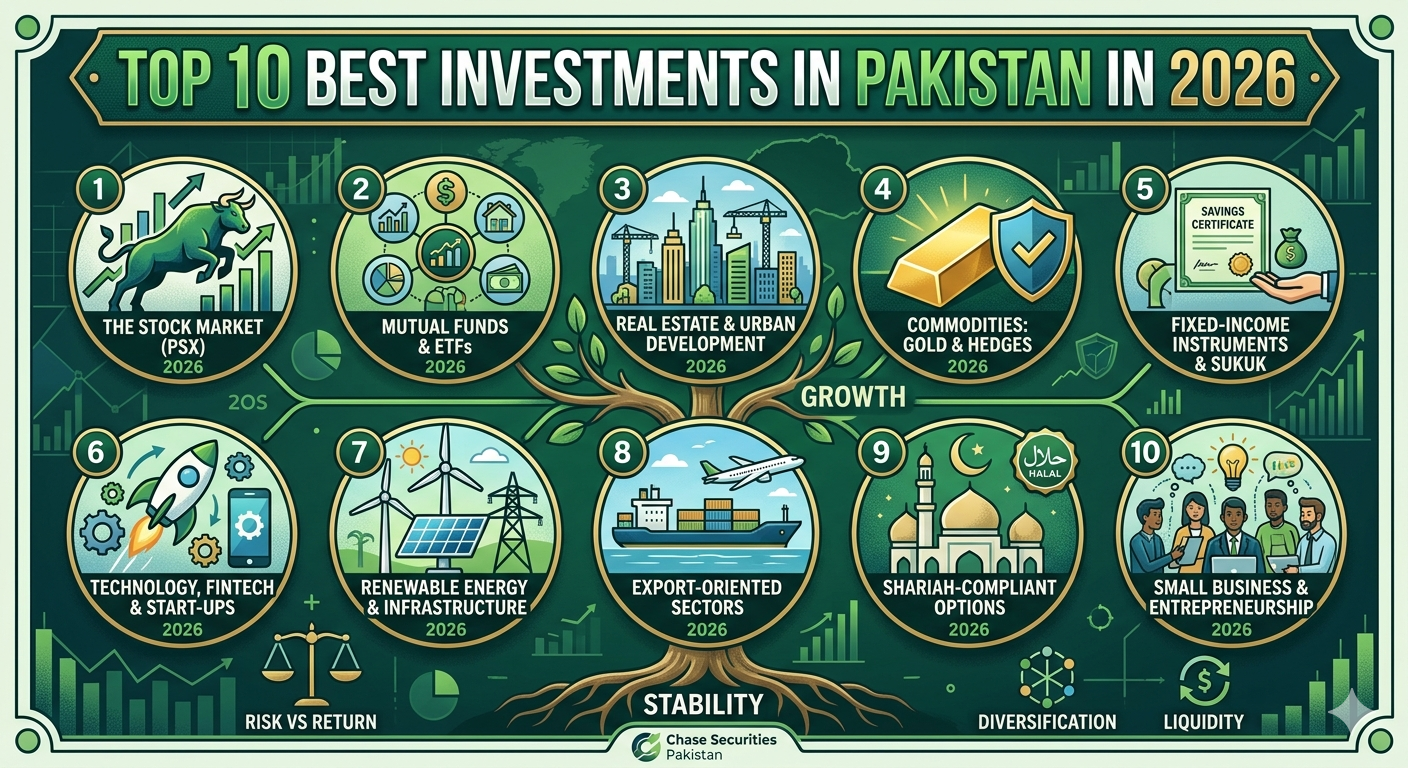
If you’re looking to grow your money in 2026, understanding the best investments in Pakistan in 2026 is essential. Below, we explore ten of the most compelling investment options in Pakistan this year. We focus on what makes each option meaningful today, what you should watch out for, and how it might fit into your portfolio.
1. The Stock Market (Pakistan Stock Exchange PSX)
Why it’s one of the best investments in Pakistan in 2026:
- The PSX remains one of the primary investment platforms in Pakistan for both capital growth and dividend income.
- With sectors such as banking, energy, exporters, and manufacturing showing renewed interest, equities offer leverage to economic recovery.
- Equity investing inherently carries higher volatility, especially in Pakistan, where currency, policy and macro risks are elevated.
- Select companies with solid fundamentals, decent free-float liquidity and decent corporate governance.
- Build a core portfolio of blue-chip stocks and dividend payers.
- Use selection filters: long history, stable earnings, trading liquidity.
- Consider using mutual funds/ETFs (see below) if you prefer a managed route.
2. Mutual Funds & ETFs
Why it’s one of the best investments in Pakistan in 2026:
- Mutual funds pool your capital and spread it across stocks/bonds, reducing single-company risk.
- ETFs (exchange-traded funds) in Pakistan are gaining traction; they offer diversification with the flexibility of a stock.
- Fees: Higher management cost reduces net return.
- Underlying holdings: Ensure the fund is aligned with what you want (growth vs income).
- Liquidity and redemptions: Ensure fund allows you to move when needed.
- For newcomers or busy investors: allocate a portion (e.g., 20-40 %) to well-rated mutual funds or ETFs, complementing your direct equity exposure.
- For experienced investors: you may mix funds with direct stocks for flexibility and diversification.
3. Real Estate & Urban Development
Why it remains relevant:- Urbanisation, infrastructure investment (including large-scale projects) and housing demand all point to growth in real estate value.
- There are opportunities in commercial real estate, plots, residential properties and even REITs (Real Estate Investment Trusts).
- Entry cost is high, many properties require significant capital.
- Liquidity can be low: selling property often takes time and involves transactions cost.
- Legal/documentation risk: ensure title, approvals, zoning are clear.
- If you can, consider smaller entry-size options (e.g., apartments, plots in emerging zones) rather than large homes only.
- Monitor trends: where roads, infrastructure, transport links are improving. those areas may offer appreciation potential.
4. Commodities: Gold, Precious Metals and Alternative Hedges
Why it’s one of the best investments in Pakistan in 2026:
- With currency risks and inflation high in Pakistan, many investors treat gold and other precious metals as a hedge.
- These assets may not provide dividend income, but they help diversify and preserve value when equities or currency are under stress.
- They don’t pay dividends or interest, their return depends on appreciation only.
- Storage, purity and transaction cost matter (for physical gold).
- Global commodity and currency cycles impact performance.
- Treat as a hedge rather than your main investment.
- You might allocate a modest percentage (5 – 10 %) of your portfolio to gold or similar assets to smooth volatility and protect against extreme events.
5. Fixed-Income Instruments, Sukuk & National Savings
Why this is important:- For risk-averse investors, government-backed savings schemes and Shariah-compliant sukuk (Islamic bond equivalents) provide relative stability.
- These offer predictable returns (though moderate) and help diversify away from pure equity risk.
- Return rates vs inflation, if inflation is high, “fixed” returns may still lose purchasing power.
- Duration and liquidity: longer-term bonds may lock you in when you’d prefer flexibility.
- Credit risk (for corporate bonds) and Shariah-compliance (if you need halal investments).
- For a balanced portfolio: allocate a component (e.g., 20-30 %) to fixed income/savings.
- Use sukuk or savings schemes for the “foundation” of your portfolio, and equities/real-estate for growth.
6. Technology, Fintech & Start-Ups
Why it has upside:- Pakistan’s technology ecosystem is growing: large youth population, rising internet/mobile penetration, policy support for digital transformation.
- Early-stage and growth opportunities can yield higher returns if you’re willing to accept higher risk.
- Start-ups & early-growth companies often have high failure rates.
- Data and valuations may be less transparent in Pakistan compared to developed markets.
- Liquidity and exit options (for private companies) may be limited.
- If new to investing: consider a small allocation (e.g., 5-10 %) to growth/tech exposure, perhaps via venture funds, specialised funds or early-stage platforms.
- If experienced: do deeper research into business model, scalability, funding and governance.
7. Renewable Energy & Infrastructure
Why it’s one of the best investments in Pakistan in 2026:
- Pakistan is investing in renewable energy, solar and wind power, and infrastructure upgrades.
- These are long-term themes: energy demand, climate policy, government incentives.
- Projects may have long timelines and large capital requirements.
- Regulatory risk: subsidy changes, policy revisions, tariff changes can impact returns.
- Technology risk: as global renewables evolve, local projects must keep pace.
- For individual investors: look at stocks of companies in renewables, solar component manufacturing, or infrastructure firms listed on PSX.
- For impact-oriented portfolios: this category blends growth and purpose.
8. Export-Oriented & Commodity Sectors
Why this can work:- Companies that earn foreign currency (exporters) or are commodity-linked (fertiliser, materials) have natural hedges when the Pakistani rupee weakens.
- Some data emphasises these sectors when external shocks occur.
- Exporters face global demand risk, currency conversion risk and cost pressures (fuel, logistics).
- Commodity-based companies often have cyclical earnings: good in boom, weak in bust.
- Check local cost structure, export markets, tariff/regulation risk.
- Include a selection of exporter or commodity-linked stocks inside your equity allocation for diversification.
- Ensure you’re comfortable with the cyclical nature of these businesses.
9. Shariah-Compliant / Ethical Investment Options
Why it’s relevant:- Many Pakistani investors want to ensure their portfolios align with Islamic finance principles (halal investing).
- Shariah-compliant funds, sukuk, and screened stocks allow alignment of faith and finance.
- Screening criteria: business model, debt levels, interest income, etc.
- Returns may differ slightly because of restriction set.
- Ensure you understand the fund’s or stock’s Shariah compliance disclosures.
- If faith is important to you: allocate a portion of investments into Shariah-compliant products.
- Ensure they still meet your growth/income goals, not just compliance.
10. Small Business, Entrepreneurship & Private Investments
Why this is a worthy option:- Investing in your own business or a trusted private venture gives control, potential high returns and meaningful personal engagement.
- Many retail investors in Pakistan lean into business ideas rather than solely financial markets.
- High risk: many small businesses fail.
- Time- and effort-intensive: you likely act as active owner rather than passive investor.
- Liquidity: exiting a business is harder than selling a listed stock.
- If you have a business idea or know the sector/trend well, allocate maybe 5-10 % of your capital to this.
- Use rigorous business plan, budgeting, risk analysis.
- Keep it manageable and within what you can afford to lose.
Bringing it all together: Portfolio strategy & tips
Here’s a simple way to think of how these ten investment types can combine into a coherent strategy:- Foundation (Stability): Fixed-income/savings, Shariah-compliant funds, modest real estate.
- Growth/Incomes: Equity (PSX stocks), mutual funds/ETFs, dividend-oriented exporter/commodity stocks.
- Themes & Extras: Technology/fintech, renewable energy, export-linked sectors.
- Optional high-risk/high-reward: Small business/private investment, higher growth tech start-ups.
- Hedge/Outlier: Gold and precious metals.
- Always weigh risk vs return: higher return potential usually means higher risk.
- Stay diversified, across asset classes, sectors and geographies.
- Do your homework: understand the business, fund or investment vehicle.
- Keep liquidity in mind: some investments are easy to buy/sell (stocks), others take time (real estate, business).
- Be aware of macro-factors specific to Pakistan: currency devaluation, inflation, regulatory changes, energy cost, etc.
- Periodically review your portfolio. Markets and your life circumstances change.