

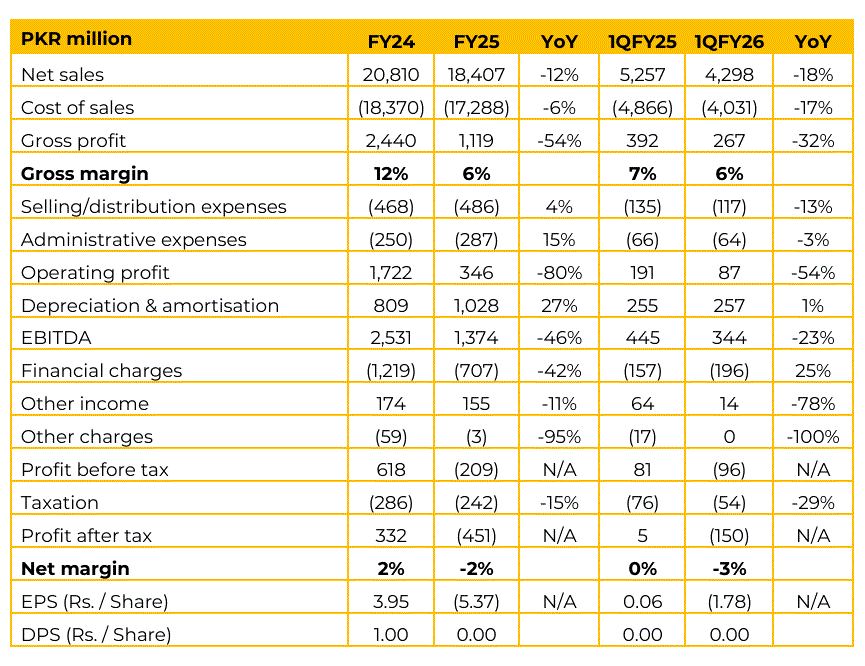
ADMM has reported loss per share of PKR 1.55 in FY25 (EPS FY24: PKR 3.95). Furthermore, in 1QFY26 the company reported LPS of PKR 1.78 (EPS 1QFY25: PKR 0.06). ADMM operates as a vertical unit encompassing spinning, fiber production, yarn, denim fabric, finishing, and garments.
The core business is primarily denim (100% denim and cotton). The company operates a fiber recycling plant that converts industrial waste (clips, used clothing, waste from spinning mills and garment units) into recycled fiber. Recycling and sustainability are particularly important in Europe. ADMM is one of the only companies internationally certified to supply recycled yarn, leading to nominations by several brands.
They maintain a mix of customers across three types of business: premium, medium, and filler (low-end). Low-end customers provide business volume all year round. The focus has shifted toward making the final product (garments), as margins have collapsed across the spectrum (spinning, weaving, dyeing) and many domestic garment companies and countries like Bangladesh have developed their own denim mills.
The past year has been an extremely challenging year due to four major headwinds. The US imposed reciprocal tariffs, delivering two major shocks: 10% in April and 20% in August. The total duty for Pakistan into the US is currently 36-37%. This led to an immediate stop in American buying, decimating margins.
To retain business, ADMM, along with competitors in Pakistan, India, and Bangladesh, had to reduce prices. Sales have dropped substantially. Gross margins have been reduced. Brands and retailers have begun absorbing the tariffs, either by reducing supplier prices or increasing retail prices. The government continuously increased gas rates (three times the previous rates). Pakistan’s gas rate is $15 per MMBTU, compared to $8 in Bangladesh and $7 in India. This is almost twice as much. When gas rates are reduced, the government
imposes a levy to force industry to switch to electric, which is extremely expensive. Labor prices are continually increasing. The minimum wage in Pakistan is $150 per person, significantly higher than Bangladesh ($75) and India ($85). The labor force is often described as illiterate, uneducated, and not skilled, leading to very low efficiency.
Rising costs include salary bills, gratuity, EOBI, and SESSI. Interest rates went as high as 22%, though they have now dropped to 11%. Debt was accumulated due to ordering equipment under LTF spending, but the company had to pay through its own resources for customs clearance, resulting in a significant hit in interest cost. The CEO noted that after 33 years of consistent profit and dividend declarations, this was the first year they had to stop giving a dividend.
Management is converting short-term financing to long-term financing now that interest rates are down (from 22% to 11%). 30% to 40% of short-term debt has been converted to long-term debt, automatically restructuring the balance sheet and bringing margin ratios in line. The business is not actively expanding; rather, it is focusing on increasing volume efficiently. The major current focus is to cut down the energy bill. The company has installed 4.8 MW of solar power and has another 1.0 MW coming.
They aim to reduce dependence on captive gas and switch to K-Electric if favorable rates are provided. Power from gas currently costs 38 rupees/unit (with levy). If K Electric were to offer energy at 33 rupees/unit, ADMM would immediately switch off gas and move to K-Electric. They have K Electric substations installed at both locations. The aim is to convert the entire spinning unit to run on solar power (and later batteries), making it independent of the grid and gas. Global cotton prices have dropped (from 92 cents to 62 cents) due to reduced international consumption after the tariffs. However, any gain from lower cotton prices was immediately lost in the selling price due to the need to reduce prices related to tariffs. A significant portion of inputs (66%) is imported, including cotton, chemicals, gas, accessories, zips, and buttons.
Going forward, the CEO believes the tariff shock has now been absorbed by the market (retailers and consumers). Orders are placed 6 months to one year in advance. The company anticipates a marked improvement in Q3 and Q4, as the main brunt of the tariff was felt in Q1 and Q2.
Management is working hard to increase garment sales and prices. The expectation is that the company “should do” double digit gross margins, provided global headwinds stabilize. Pakistan is no longer a low-cost producer. Labor costs are higher than Bangladesh and India.
The country is at the “very last end of the chain” in textile exports, trailing China (33% of American textile), Vietnam, and Cambodia. A current positive trend is that American brands are starting to use Pakistan as an alternative supplier to Bangladesh due to political issues there. These American customers (who can fill the factories, unlike smaller European customers) are expected to shift around 30% of their production to Pakistan, while 70% remains in Bangladesh.
Important Disclosures
Disclaimer: This report has been prepared by Chase Securities Pakistan (Private) Limited and is provided for information purposes only. Under no circumstances, this is to be used or considered as an offer to sell or solicitation or any offer to buy. While reasonable care has been taken to ensure that the information contained in this report is not untrue or misleading at the time of its publication, Chase Securities makes no representation as to its accuracy or completeness and it should not be relied upon as such. From time to time, Chase Securities and/or any of its officers or directors may, as permitted by applicable laws, have a position, or otherwise be interested in any transaction, in any securities directly or indirectly subject of this report Chase Securities as a firm may have business relationships, including investment banking relationships with the companies referred to in this report This report is provided only for the information of professional advisers who are expected to make their own investment decisions without undue reliance on this report and Chase Securities accepts no responsibility whatsoever for any direct or indirect consequential loss arising from any use of this report or its contents At the same time, it should be noted that investments in capital markets are also subject to market risks This report may not be reproduced, distributed or published by any recipient for any purpose.