
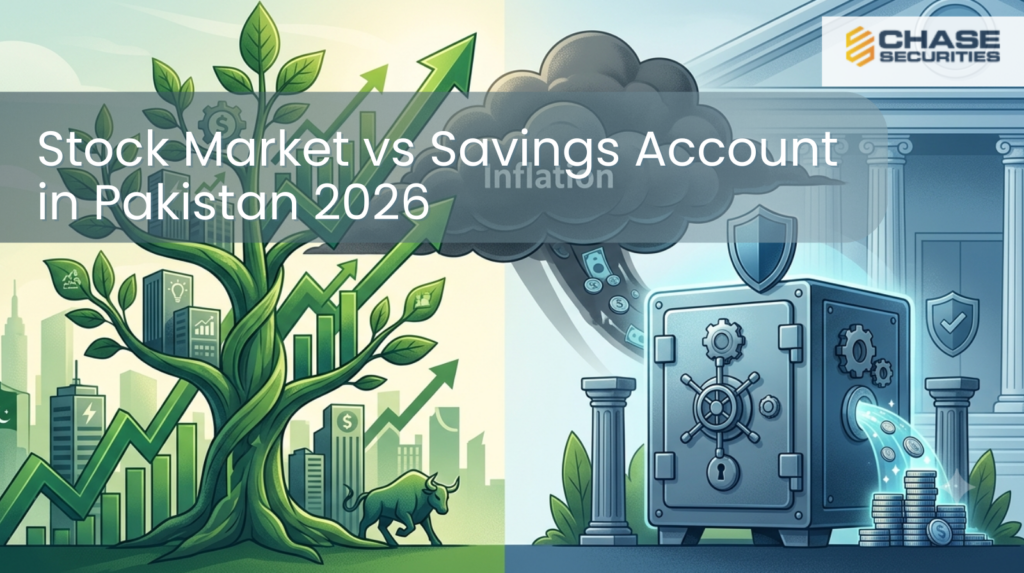
Stock Market vs Savings Account in Pakistan: Which Beats Inflation?
If you are serious about growing your money in 2026, one question matters more than ever:
Should you keep your money in a savings account, or invest in the stock market?
With rising prices, currency pressure, and economic uncertainty, understanding Stock Market vs Savings Account in Pakistan is critical for protecting your purchasing power.
This article compares returns, risk, inflation impact, liquidity, and long-term wealth creation, so you can decide what actually helps your money grow.
Why Inflation Is the Real Enemy?
Before comparing investment options, we must understand inflation.
Inflation reduces your purchasing power.
If inflation is 15% and your money grows at 10%, you are actually losing 5% in real terms.
In Pakistan, inflation has historically been volatile. That makes investment decisions even more important.
Your goal is not just to earn returns.
Your goal is to beat inflation consistently.
What Is a Savings Account?
A savings account is offered by banks and provides:
- Capital protection
- Fixed or variable interest
- High liquidity
- Low risk
It is commonly used for emergency funds and short-term savings.
Advantages of a Savings Account
- Safe and regulated
- Easy access to cash
- No market volatility
- Simple to manage
Limitations
- Returns often barely match inflation
- Interest income is taxed
- No long-term wealth compounding
Savings accounts protect capital, but rarely grow wealth significantly.
What Is the Stock Market?
The stock market allows you to buy ownership in companies listed on the Pakistan Stock Exchange (PSX).
When you invest in stocks, you benefit from:
- Capital appreciation
- Dividends
- Business growth
Unlike savings accounts, stock returns are not fixed.
They fluctuate, but historically, they outperform inflation over the long term.
Historical Return Comparison
Savings Account Returns
Bank savings accounts typically offer returns linked to policy rates.
While rates may rise during high inflation, they often lag behind actual price increases.
After taxation and inflation adjustment, real returns are frequently low or negative.
Stock Market Returns
The stock market grows based on:
- Corporate earnings
- Economic expansion
- Dividend reinvestment
Over long periods, equity investments tend to outperform fixed deposits and savings accounts.
Short-term volatility exists.
Long-term growth potential is higher.
Inflation Impact: Real Example
Let’s assume:
- Inflation: 12%
- Savings account return: 10%
- Stock portfolio average return: 18%
In this case:
Savings account = –2% real return
Stock portfolio = +6% real return
The difference compounds over time.
After 10 years, the gap becomes significant.
Inflation silently erodes idle cash
Risk: Safety vs Growth
Savings Account Risk
- Very low risk
- Capital protected
- No volatility
Ideal for emergency funds.
But low risk often means low reward.
Stock Market Risk
- Market volatility
- Economic downturns
- Company-specific risk
However, diversification reduces overall portfolio risk.
Risk decreases with longer investment horizons.
Time in the market matters more than timing the market.
Liquidity Comparison
Both savings accounts and stocks offer liquidity, but differently.
Savings Account
- Immediate access
- Withdraw anytime
Stock Market
- Sell shares during market hours
- Settlement within a few working days
While savings accounts offer instant liquidity, stocks still provide reasonable flexibility compared to property or other investments.
Compounding: The Wealth Multiplier
Compounding means earning returns on previous returns.
Savings accounts compound slowly due to lower interest rates.
Stocks compound faster due to:
- Higher growth potential
- Dividend reinvestment
- Capital gains
Over 15–20 years, compounding in equities can significantly outperform savings returns.
Short-Term vs Long-Term Goals
Use Savings Account For:
- Emergency fund
- Short-term goals (1–2 years)
- Low-risk capital preservation
Use Stock Market For:
- Long-term wealth creation
- Retirement planning
- Beating inflation
- Building passive income
Both serve different purposes.
Tax Considerations
Savings Account
- Interest income taxed
- No capital growth advantage
Stock Market
- Capital gains tax applies
- Dividend tax applies
- Potential higher after-inflation returns
Tax impact depends on policy, but higher growth potential often offsets tax costs in equities.
Psychological Comfort
Savings accounts feel safe because balances do not fluctuate daily.
Stock markets show daily price changes, which can create emotional stress.
However, volatility does not equal permanent loss.
Investors who remain disciplined during downturns often benefit the most during recoveries.
Can You Combine Both?
Yes, and you should.
A smart financial structure may look like this:
- 3–6 months expenses in savings account
- Long-term investments in stock market
- Diversified portfolio across sectors
Savings accounts provide stability.
Stocks provide growth.
Balance reduces overall financial stress.
Who Should Prefer Savings Accounts?
- Risk-averse individuals
- Retirees seeking capital safety
- Short-term planners
- Those building emergency funds
Who Should Prefer Stock Market?
- Young professionals
- Long-term investors
- Individuals seeking inflation-beating returns
- Those comfortable with short-term volatility
Time horizon plays a crucial role.
The longer your horizon, the more equities make sense.
Final Verdict: Which Beats Inflation?
When comparing Stock Market vs Savings Account in Pakistan, the answer depends on your goal.
If your goal is:
Capital protection → Savings account works.
Wealth growth → Stock market wins long-term.
Inflation punishes idle cash.
Savings accounts may protect your money, but stocks grow it.
The smartest strategy is not choosing one over the other.
It is using both strategically.
Conclusion
Inflation is unavoidable.
Your financial strategy determines whether you lose purchasing power, or build wealth.
In Pakistan’s economic environment, relying solely on savings accounts may limit your financial growth.
The stock market carries risk, but also offers long-term potential to outperform inflation.
The key is discipline, diversification, and patience.
Money grows where strategy exists.
Get started with us today, click here to open your PSX trading account with Chase Securities.