
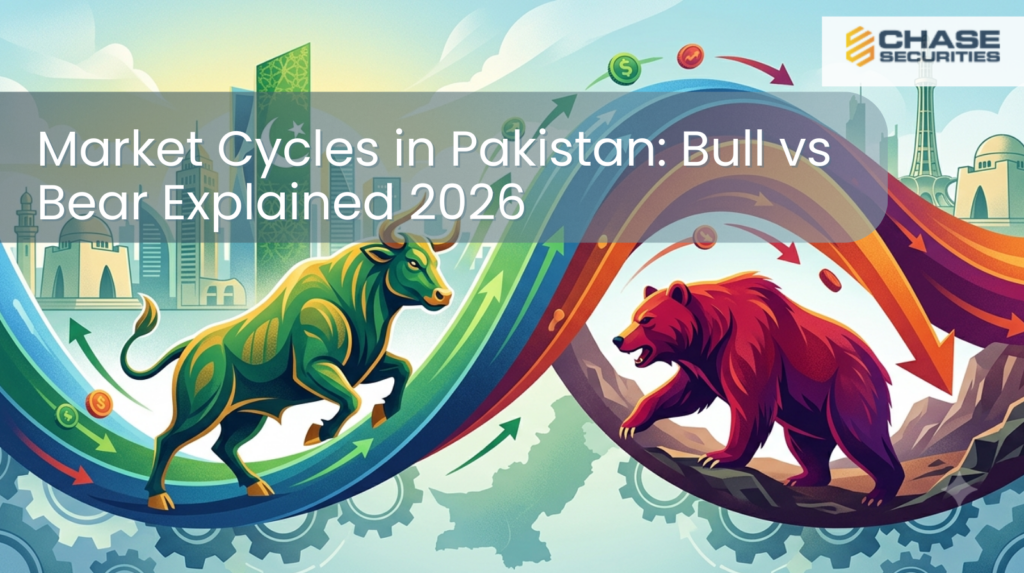
Understanding Market Cycles in Pakistan: Bull vs Bear Markets Explained
If you invest in the Pakistan Stock Exchange (PSX), one truth becomes clear very quickly:
Markets do not move in a straight line.
They rise.
They fall.
They recover.
And the cycle repeats.
Understanding Market Cycles in Pakistan is one of the most important skills an investor can develop. It helps you avoid panic during downturns and avoid overconfidence during rallies.
In this guide, we will explain bull and bear markets, how cycles work in Pakistan, and how you can position your portfolio wisely in 2026 and beyond.
What Are Market Cycles?
A market cycle refers to the natural rise and fall of the stock market over time.
Every cycle has four phases:
- Accumulation
- Markup (Bull Market)
- Distribution
- Markdown (Bear Market)
These cycles are driven by:
- Economic growth
- Interest rates
- Inflation
- Political stability
- Investor sentiment
No cycle lasts forever.
Understanding where we stand in the cycle can improve investment decisions.
What Is a Bull Market?
A bull market occurs when stock prices rise consistently over a sustained period.
It is characterized by:
- Strong investor confidence
- Rising corporate earnings
- Increasing trading volumes
- Positive economic outlook
In Pakistan, bull markets often coincide with:
- Economic reforms
- Stable currency
- Lower interest rates
- Strong foreign inflows
During bull phases, optimism dominates.
Investors feel confident.
Risk appetite increases.
What Is a Bear Market?
A bear market is a prolonged period of falling stock prices.
It usually happens when:
- Inflation rises sharply
- Interest rates increase
- Political instability grows
- Economic slowdown occurs
Bear markets often create fear and uncertainty.
Investors sell.
Liquidity tightens.
Valuations compress.
However, bear markets are temporary, not permanent.
The Four Phases of Market Cycles
1. Accumulation Phase
This phase begins after a major decline.
Characteristics:
- Prices stabilize
- Smart money starts buying
- News still feels negative
- Sentiment remains cautious
Experienced investors quietly accumulate stocks during this phase.
2. Markup Phase (Bull Market)
Confidence returns.
Characteristics:
- Prices rise steadily
- Earnings improve
- Retail investors enter
- Media turns optimistic
This is when most people notice the rally.
3. Distribution Phase
Market momentum slows.
Characteristics:
- Prices move sideways
- Volatility increases
- Large investors start selling
- Valuations become stretched
This is often the most difficult phase to identify.
4. Markdown Phase (Bear Market)
Prices fall sharply.
Characteristics:
- Panic selling
- Negative headlines
- Margin calls
- Reduced investor confidence
This phase creates opportunity for long-term investors.
How Market Cycles in Pakistan Are Unique?
While global trends influence PSX, Pakistan has specific drivers:
1. Interest Rates
High interest rates often slow equity growth because investors shift toward fixed income.
Lower rates usually boost stock market performance.
2. Currency Movement
Rupee depreciation impacts:
- Import-heavy industries
- Export-driven companies
- Inflation expectations
Currency stability often supports bullish sentiment.
3. Political Stability
Political transitions heavily impact investor confidence in Pakistan.
Periods of clarity often support bull markets.
Uncertainty can trigger bear phases.
Why Most Investors Lose Money in Cycles?
Investors often:
- Buy during bull market peaks
- Sell during bear market lows
- React emotionally to news
- Ignore long-term strategy
This behavior creates losses.
Successful investors do the opposite:
- Accumulate during fear
- Stay disciplined during rallies
- Avoid panic selling
Understanding Market Cycles in Pakistan reduces emotional mistakes.
How to Invest During a Bull Market
During bull markets:
- Avoid over-leveraging
- Focus on fundamentally strong companies
- Avoid chasing hype stocks
- Gradually book profits if valuations become extreme
Bull markets reward discipline, not greed.
How to Invest During a Bear Market?
Bear markets create long-term opportunity.
Smart strategies include:
- Dollar-cost averaging
- Investing in strong balance sheet companies
- Reinvesting dividends
- Maintaining liquidity
History shows markets eventually recover.
Patience is powerful.
How Long Do Market Cycles Last?
There is no fixed duration.
Bull markets may last several years.
Bear markets may last months or longer.
Cycle duration depends on:
- Economic conditions
- Global trends
- Domestic policy decisions
Predicting exact timing is nearly impossible.
Preparing for cycles is more effective than predicting them.
Long-Term Perspective: The Bigger Picture
Despite multiple downturns, stock markets globally trend upward over decades.
Why?
Because businesses grow.
Earnings expand.
Economies develop.
Pakistan’s market has experienced volatility, but long-term investors who remained disciplined often benefited from recoveries.
Time smooths volatility.
Risk Management Through Cycles
To survive all phases:
- Diversify across sectors
- Avoid excessive debt
- Maintain emergency funds
- Stay invested long-term
- Avoid emotional trading
Market cycles test patience.
Risk management ensures survival.
Should You Try to Time the Market?
Trying to perfectly time entry and exit points rarely works consistently.
Even professionals struggle.
Instead:
- Focus on valuation
- Invest systematically
- Think long-term
Time in the market beats timing the market.
Psychological Side of Market Cycles
Bull markets create greed.
Bear markets create fear.
Successful investors control emotions.
Discipline separates investors from speculators.
Understanding cycles builds emotional resilience.
Final verdict
Understanding Market Cycles in Pakistan helps you:
- Avoid panic during downturns
- Avoid euphoria during rallies
- Make rational decisions
- Stay focused on long-term wealth
Bull and bear markets are natural.
They are not enemies.
They are opportunities at different stages.
If you accept that markets move in cycles, you stop reacting emotionally, and start investing strategically.
Conclusion
Markets rise.
Markets fall.
Markets recover.
That is the nature of investing.
Bull markets build confidence.
Bear markets build wealth, for those prepared.
Instead of fearing cycles, understand them.
Because long-term success belongs to those who stay disciplined through every phase.
Get started with us today, click here to open your PSX trading account with Chase Securities.