
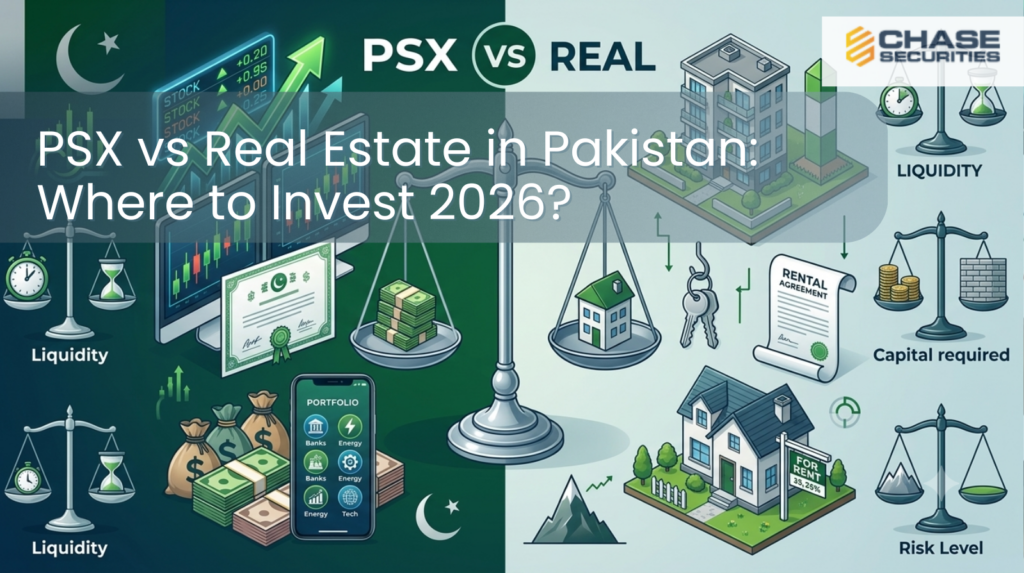
PSX vs Real Estate in Pakistan: Where Should You Invest in 2026?
Investors in Pakistan often face one big question:
Should I invest in the Pakistan Stock Exchange (PSX) or buy real estate?
Both asset classes have created wealth. Both carry risks. And both respond differently to inflation, interest rates, and economic cycles.
In 2026, with evolving regulations, digital access to markets, and changing property dynamics, understanding PSX vs Real Estate in Pakistan is more important than ever.
This guide breaks down returns, risk, liquidity, capital requirements, taxation, and long-term potential, so you can make a smart, informed decision.
Understanding PSX and Real Estate Basics
Pakistan Stock Exchange (PSX)
PSX allows you to invest in:
- Publicly listed companies
- Banks, energy, cement, technology, FMCGs
- Dividend-paying stocks
- Growth-oriented companies
You can start with relatively small capital and build a diversified portfolio.
Real Estate in Pakistan
Real estate includes:
- Residential plots
- Houses
- Apartments
- Commercial property
- Rental investments
Property investment has long been considered “safe” in Pakistan due to tangible ownership and inflation protection.
But safety and returns are not always the same thing.
Returns: Which Has Performed Better?
Historically:
- PSX has delivered strong long-term returns during economic expansions.
- Real estate has seen cyclical booms, especially in major cities.
PSX Returns
Stock markets grow with:
- Corporate earnings
- Dividend reinvestment
- Economic expansion
Compounding plays a major role. Reinvested dividends significantly boost long-term returns.
Real Estate Returns
Property gains usually come from:
- Capital appreciation
- Rental income
However, appreciation often depends on location, development projects, and market sentiment.
Real estate can remain stagnant for years if demand slows.
Liquidity: Access to Your Money
Liquidity is a major difference in PSX vs Real Estate in Pakistan.
PSX Liquidity
- Stocks can be sold within minutes during market hours.
- Settlement usually occurs within a few working days.
- No lengthy paperwork.
You can partially liquidate holdings easily.
Real Estate Liquidity
- Selling property can take months.
- Market demand may be low.
- Transaction costs are high.
You cannot sell “half” your plot easily.
Liquidity favors PSX.
Capital Requirement: Entry Barrier
PSX
- You can start investing with a relatively small amount.
- Fractional portfolio diversification is possible.
- Systematic monthly investing is easy.
Ideal for salaried professionals and small investors.
Real Estate
- Requires large upfront capital.
- Additional costs include:
- Transfer fees
- Stamp duties
- Agent commissions
- Development charges
Entry barrier is significantly higher.
Risk Comparison
Both investments carry risk, but in different ways.
PSX Risks
- Market volatility
- Economic downturns
- Company-specific risks
Stock prices fluctuate daily.
But diversification reduces risk significantly.
Real Estate Risks
- Legal disputes
- Fraudulent documentation
- Delayed development
- Illiquidity
- Overpricing during speculative booms
Unlike stocks, real estate risk is often concentrated in one asset.
Diversification in property requires substantial capital.
Inflation Protection
Pakistan has experienced recurring inflation cycles.
Real Estate as Inflation Hedge
Property prices and rents often rise with inflation.
Construction costs increase, pushing valuations upward.
However, inflation-driven rate hikes can reduce buyer demand.
PSX as Inflation Hedge
Certain sectors benefit from inflation:
- Energy
- Cement
- FMCGs
- Export-oriented companies
Companies can pass increased costs to consumers, protecting margins.
Dividend growth can outpace inflation over time.
Both assets can hedge inflation, but performance depends on economic conditions.
Diversification Advantage
PSX
In PSX, you can invest in:
- 10–20 companies across sectors
- Dividend and growth stocks
- Different market capitalizations
Real estate
In real estate, diversification is expensive.
Most investors hold:
- One or two properties
- Often concentrated in one city
Diversification lowers overall risk. PSX offers easier diversification.
Taxation Considerations (2026 Outlook)
Tax policies evolve, but generally:
PSX
- Capital gains tax applies
- Dividend income taxed
- Transparent documentation
Real Estate
- Capital gains tax
- Advance tax
- Withholding taxes
- Valuation disputes
Property taxation can be complex and subject to regulatory changes.
Income Generation: Passive Cash Flow
PSX Income
Dividend stocks provide:
- Quarterly or annual payouts
- Reinvestment opportunities
Dividend yield varies but can provide consistent income.
Real Estate Income
Rental income can provide steady cash flow.
However:
- Vacancy risk exists
- Maintenance costs reduce net return
- Tenancy disputes may arise
Rental yield in many cities remains relatively low compared to property value.
Volatility vs Stability
- PSX prices move daily. This creates emotional pressure.
- Real estate prices appear stable because transactions are infrequent.
- But lack of price transparency does not eliminate risk.
- Sometimes property values silently stagnate.
- Volatility is visible in PSX. Illiquidity hides volatility in real estate.
Long-Term Wealth Creation
Over long horizons:
- Stocks benefit from compounding.
- Dividends accelerate growth.
- Corporate earnings expand with GDP growth.
Real estate builds wealth primarily through appreciation and leverage.
Both can create wealth, but strategy matters.
Who Should Choose PSX in 2026?
PSX may be suitable if you:
- Have limited starting capital
- Want liquidity
- Prefer diversification
- Are comfortable with short-term volatility
- Seek long-term compounding
Who Should Choose Real Estate in 2026?
Real estate may suit you if you:
- Have large capital
- Prefer tangible assets
- Want rental income
- Can handle illiquidity
- Are comfortable with legal processes
Can You Invest in Both?
Yes.
A balanced portfolio might include:
- 60% equities (PSX)
- 40% real estate
Or adjust based on risk appetite.
Diversification across asset classes reduces overall portfolio risk.
Final verdict
There is no universal answer.
The better choice depends on:
- Capital size
- Risk tolerance
- Time horizon
- Income goals
- Liquidity needs
In 2026, PSX offers accessibility, diversification, and compounding.
Real estate offers tangible ownership and potential inflation protection.
Smart investors analyze both, and align investments with long-term financial goals.
Conclusion
The debate around PSX vs Real Estate in Pakistan will continue.
Both asset classes can create wealth.
Both carry risk.
If you want flexibility, liquidity, and lower entry barriers, PSX may be ideal.
If you value physical assets and long-term property ownership, real estate may suit you.
The best investment is not the trendiest one.
It is the one aligned with your strategy.
Invest with clarity, not emotion.
Get started with us today, click here to open your PSX trading account with Chase Securities.