
How to Build a Diversified Portfolio
Why Diversification Matters
A diversified portfolio is the cornerstone of smart investing. Rather than betting on a single stock or asset class, spreading your money across different investments reduces your exposure to any one outcome.
Here are the key benefits:
- Reduced risk: If one investment fails, others can cushion the blow.
- Lower volatility: Returns become smoother over time; downturns in one sector don’t derail your entire portfolio.
- Access to various growth cycles: Different assets perform well in different economic conditions, balancing growth, income, stability.
- Better risk-adjusted returns: Mixing growth-oriented and stable investments helps balance reward and safety.
Because no one can predict which sector or asset will outperform, diversification increases your chances of capturing returns while protecting capital.
Step 1: Set Goals & Know Your Risk Tolerance
Before you build your diversified portfolio, define your financial goals and how much risk you can handle.
- Short-term goals (1–3 years): You might prioritize cash, fixed income, or safe assets.
- Mid-term goals (3–10 years): A balanced mix of fixed income and equities may make sense.
- Long-term goals (10+ years): Equities and growth assets tend to offer the best return potential over long horizons.
Your risk tolerance depends on income stability, other savings, and emotional capacity to handle volatility.
Step 2: Spread Investments Across Asset Classes
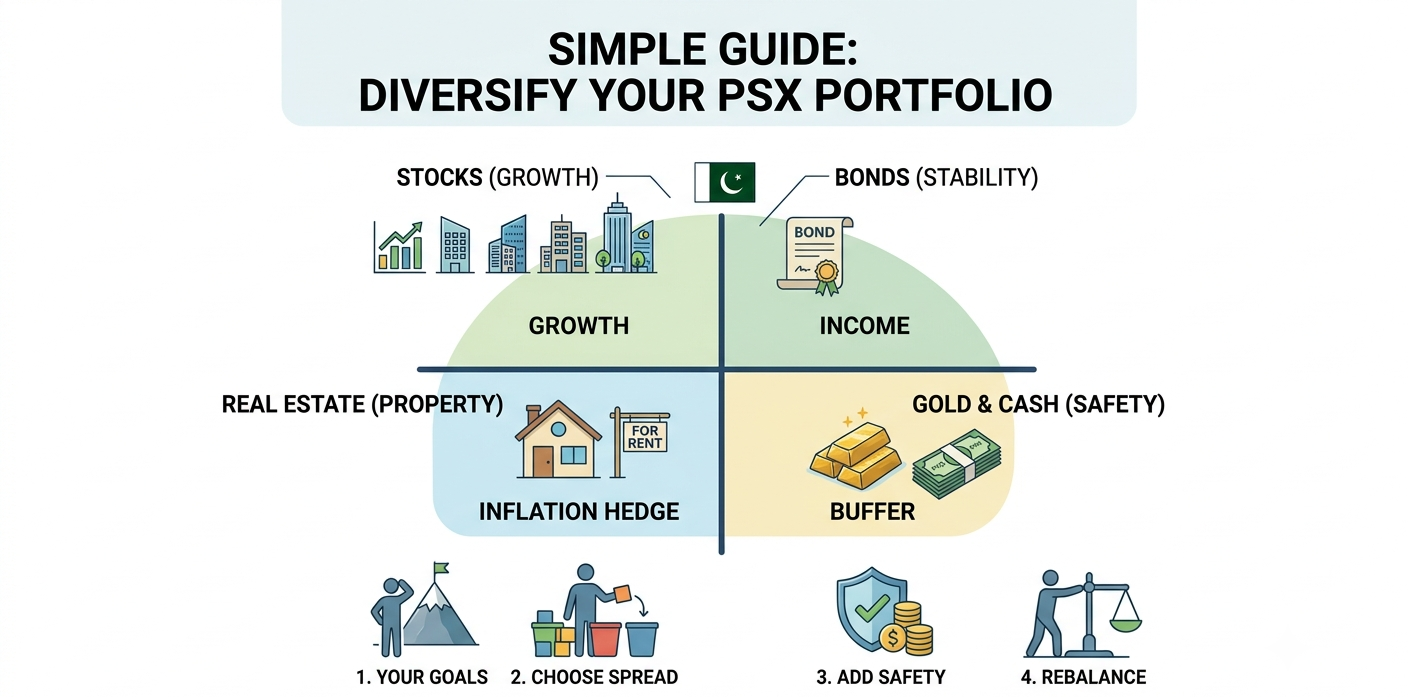
A broadly diversified portfolio doesn’t just mean many stocks. It means a mix of asset classes, such as:
- Equities (stocks) for growth potential
- Fixed income (bonds, government securities) for stability and income
- Real estate or REITs / alternative assets to hedge inflation and add variety
- Commodities or precious metals sometimes acting as a hedge against economic instability or currency depreciation
For example, a moderate-risk portfolio might contain 50% stocks, 30% bonds, 10% real estate/alternatives, 10% commodities/cash.
This mix balances growth and safety while giving exposure to different economic drivers.
Step 3: Diversify Within Each Asset Class
Inside equities (or other classes), more diversification helps reduce risk further. For stocks, that means:
- Different industries/sectors: Technology, banking, consumer goods, energy, etc.
- Different company sizes: Large-cap, mid-cap, small-cap, each behaves differently over market cycles.
- Geographic/international exposure: If possible, helps hedge against country-specific risk.
For beginners or those with limited capital, index funds or ETFs are a great tool, they bundle many stocks and provide instant diversification with low cost.
Financial literature suggests that owning 25–30 stocks across sectors or using broad-market funds can deliver strong diversification benefits.
Step 4: Include Defensive Assets & Income Streams
Not all investments should chase growth. A portion of your portfolio should aim for stability, especially if you have medium- or short-term needs.
- Bonds or fixed-income securities provide regular income and lower volatility compared to equities.
- REITs or real estate exposure offers inflation protection and diversification away from financial markets.
- Commodities/commodities-related assets (like precious metals) can hedge against currency depreciation or inflation, relevant for investors in emerging markets.
This mix boosts resilience when markets are volatile.
Step 5: Rebalance Periodically & Monitor Costs
Diversification is not “set and forget.” Over time, some parts of your diversified portfolio will grow faster than others, shifting your asset allocation. That can increase risk without you realizing it.
- Rebalance annually or semi-annually: Sell part of over-weighted assets, and add to under-weighted ones.
- Watch fees and liquidity: High transaction costs or illiquid assets can drag performance.
- Stay disciplined: Avoid reacting emotionally to market swings, diversification exists partly to smooth those swings.
Example: What PKR 100,000 Could Look Like
Imagine you have PKR 100,000 to invest today with a medium-risk profile and 5–10 year horizon. Here’s a balanced allocation:
| Asset Class | Allocation | Amount (PKR) |
| Equities (broad market ETF or diversified stocks) | 50% | 50,000 |
| Bonds / Fixed Income | 25% | 25,000 |
| Real Estate/REIT or alternatives | 15% | 15,000 |
| Commodities / Precious metals / Cash buffer | 10% | 10,000 |
Over time, this portfolio will benefit from growth (equities), stability (bonds), inflation hedge (real estate/commodities) and liquidity. If markets are volatile, not all assets move in the same direction, smoothing returns and lowering the risk of big losses.
Common Mistakes in Diversification
- Over-concentrating in one sector or asset class (e.g. only tech stocks). This defeats the purpose of diversification.
- Failing to rebalance, letting a few high-performers dominate your portfolio over time.
- Ignoring costs & liquidity, holding illiquid assets or expensive funds that eat into returns.
- Chasing performance instead of sticking to a plan, which often leads to buying high and selling low.
5-Step Checklist to Start Right Now
- Define your investment goal (short-, mid-, or long-term) and risk tolerance.
- Allocate across at least 3 asset classes (equities, fixed income, alternatives).
- Diversify inside each class (different sectors, sizes, geographies).
- Add stable income or defensive assets (bonds, real estate, cash, commodities).
- Set a schedule to review and rebalance, once or twice per year.
Start Your Diversified Investment Journey
Building a well-structured, diversified portfolio becomes much easier when you have the right guidance. At Chase Securities Pakistan (Pvt.) Ltd., we support investors with research-backed insights, risk-aligned asset allocation, and transparent execution. Whether you’re starting with PKR 10,000 or managing a large portfolio, our team helps you diversify across sectors, asset classes, and long-term opportunities on the PSX. With licensed advisors, real-time market research, and a focus on investor education, we ensure you make decisions confidently, not emotionally.
If you’re ready to build a smarter, safer, and more balanced portfolio, our team is here to help you take the next step.
FAQs
Q: Is diversification the same as owning many stocks?
A: Not exactly, diversification means spreading across asset classes, sectors, geographies, and investment types, not just increasing the number of holdings.
Q: How often should I rebalance my portfolio?
A: Ideally, once every 6–12 months, or whenever your allocation drifts significantly from your target.
Q: Can diversification guarantee no losses?
A: No, it reduces risk but does not eliminate it. Diversified portfolios still face market-wide events.